First, we went over our homework. We learned that a physical change is when an object changes, but does not effect their chemical nature. An example of this is wood turning into a baseball bat. The next thing we went over is a chemical change which is when substances change into different substances. An example of this is burnind wood. Most of the time, chemical changes relate to rearangment of atoms. One more thing is that physical changes are reversable and chemical changes aren't. After that, we start to think about an experiment. We have to filter an ice cub to see all the materials in it. The materials are iorn, wood shavings, sugar, water, and sand(I'm not 100 percent sure on sand).For this specific experiment, my group decided to make an experiment we did in the 5th grade. We will put the cube in a transparent cup, and leave it alone for a while. After waiting for a day we should see the most dense materials on the bottom and the least dense materials on the top. We can just take each part out from top to bottom and we will have all the materials in seperate spaces. We also have our test on friday. Mr.Finley posted a study guide on the website and I highly recomend you check it out. Our lab report is also due friday.
PS I can't add an image because the "add picture" button was not working for my computer. If I were to add a picture, I would have shown a burning fire, and a glass with the least density on the top and the most dense on the bottom
MP
Tuesday, February 15, 2011

First in class, we went over our homework. The definition of a physical change is when an object changes but does not affect their chemical nature. Some examples of this is when wood becomes a baseball bat or melting ice. The definition of a chemical change is when substances change into different substances. An example of this are burning wood. We learned that typically, chemical changes relate to rearrangement of atoms. Another thing about physical and chemical changes is that physical changes are reversable, while chemical changes aren't. We also have a test on friday, so start studying. Mr. Finley posted a study guide on the website to help us and I highly recommend you check it out. After we went over homework, we discussed and experiment. We had to filter out an ice cube to see the materials inside. The materials are iorn, wood chips, sugar, water, and sand(im not 100 percent on sand). My group had the idea that if we put the materials in a cup, the less dense materials will go to the top, and the more dense will go to the bottom. Then, we can just take the materials out. Lastly, our lab reports are due on friday. So, I hope this will keep you up to date.
Thursday, February 10, 2011
Thursday February 10th
We continued discussion of the topic from the end of class yesterday. About how the number of atoms of each type must equal out on each side of the equation.
For example: H2+O2 yields H2O had to be changed to 2H2+O2 yields 2H2O
The three methods we learned to solve these types of problems are using pictures, writing the numbers of each element, and using ratios. The first two are the easiest methods to use.
I cannot create the picture method here but ill show the other ones.
H2+O2 yields H2o 1.to start write the number of each type of atom for each side
H=2 H=2 2. you can see that there is a different number of oxygens on
O=2 O=1 each side. To correct this you need to add more molecules.
H2+O2 yields 2H2O 3. Now the oxygens are equal but the hydrogens are different. To
H=2 H=4 correct this you need another Hydrogen molecule.
O=2 O=2
2H2+O2 yields 2H2O 4. This is you final answer.
A major part of this is that you cannot have fractions such as H1/2 because half of H would become a different element.
All of this has to do with conservation of mass. There must be and equal number of each type on each side otherwise something has gone wrong. Imagine you have just finished chocolate chip cookies. You put them in the oven and when you come back later the chocolate chips are gone. You absolutely know that you put the chocolate chips in the cookies so you start to freak out because this is impossible.
That is basically what we are dealing with when we do these problems. The mass must stay the same. Nothing can just vanish.
Tomorrow we are starting to work with Bunsen burners. We will deal with the type of chemical reaction called decomposition.
-JP
Monday, February 7, 2011
Feb 7, 2011
We started by recreating the concept map on the smart board. We had to connect the terms particle, atom, molecule, ion, proton, nuetron, isotope, electron, and element. We gave the connections and answers and Fin drew it. He also talked about how the mass of an atom came from the protons and neutrons, but not the electrons. For extra credit: look up the mass of protons, neutrons, and electrons. Then compare them. He put a piece of paper in a box with two chimneys and let the paper smolder. He told us to figure out which chimney the smoke would go through. He did the same thing again but he put a lit candle underneath the other chimney and told us to figure out which chimney the smoke would go up now. The only hint he gave us was that the box was called a convection chamber. The candle heated up the air making it less dense and it rose up. The smoke rushed to the empty space and was heated up by the candle and it rose out Chimney A instead of Chimney B.
G Stum
Friday, February 4, 2011
Today in class we reviewed the homework," More Matter...it matters". We discussed what experiments could be performed to see if heat can be added or removed from a system. Someone said we should measure a closed container of water's weight and place it on a stove and see if the weight increased.

In class, we performed a similar experiment. We lit a blade of metal. The metal weighed 7.9 grams before we lit it. After it was lit, the weight remained the same. This disproved Elmar's idea of heat which was it can be added or removed from a object.
By doing this experiment, we learned:
*Heat isn't a physical, if it was metal would've gotten heavier.*
*Heat is a process,it's the movement of particles.*
We defined conduction by stating it was the transfer of energy by touching. (particle to particle)
We defined convection by stating that it was the transfer of energy through fluids(ex.water,air,play-doh, jello,etc.)
Fluids- are not state, it's a classified combination of liquid or gas.
Mr.Finley asked us why the goo in the lava lamp moves?
Our answer was that the goo was heated up by the energy source.(light).
The exact process on how a lava lamp really works is :
energy source shoots out light waves ~ waves hit particles, particles move faster ~ particles spread out ~ substance expands ~ substance is less dense(particles are spread out in it),so it floats ~ floats to the top ~ substance is further away from energy source ~ energy (particles) transferred to environment which means substance has less energy ~ particles are moving slower ~ particles condense,(denser) so sink to bottom ~ cycle starts again because goo is closer to the energy source (light) again
AR (3rd)
Thursday, February 3, 2011
Today we started with checking the home work. Then Mr. Finley went over what we did on Teusday. We went over how scientists said that when they rubbed their hands together they were leaking phlagastun (flag-a-stun). Then they called it heat. We went over how the scientists tried to find out how heat works. They came up with some crazy ideas like how they were swimming in a liquid of heat and other ideas. Then Fin started complaining about how people misuse the word "heat" in our language like how people ask each other to turn up the heat. Then he asked a lot of people to stand in a line and hold each other's hands. Then he explained how the people are particles in a spoon and Finley was the soup. Then, he explained how the particles moved around. Everyone in the line shook their arms to show movement. DB pointed out that the people model shows that energy travels in waves. Then we talked about energy waves and about solar flares. Then Fin asked what would a star's radiation affect? We said that it would shut down all sorts of technology like cell phones and satelites. Then we had a quick talk about pop-tarts, hotpockets and peeps and how they explode. Then we talked about the radiation of heat in a micrwave and how it's bad to watch things heat up in the microwave. Then he talked about how radiation affects the body by giving you sunburn. Then he talked about how we dropped aan atomic bomb in WWII that has radiatioin. Then Fin said that even though a bomb was dropped 100 miles from a house far they would still be affected because the radiation travels in waves and travels far. Then he showed us a simulation on PhEt and that if he increased the amount of waves, the faster the particles moved. Then he asked the groups to duscuss how the microwave worked on PhEt simulation. Then he asked the groups to discuss how a thermomiter works. We then quikly went over how it works. Then it was time to go.
WR
WR
Tuesday, February 1, 2011
February 1, 2011 - Different Types of Heating
Today, we went over homework and took the science quiz scheduled for yesterday. The homework was to find 3 types of heating. Here are the three types:
- Convection
- Conduction
- Radiation

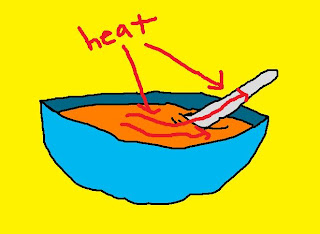
Conduction is the transfer through matter from particle to particle. Conduction is most effective in solids, but it may occur in fluids. An example of conduction is a spoon in some hot soup. The spoon becomes warmer becomes warmer because the heat is conducted along
the spoon. Another example of conduction is when you touch metal. When you touch a metal spoon, it usually feels colder than you. The metal spoon is not colder though. It only feels colder because it conducts heat away from your hand.
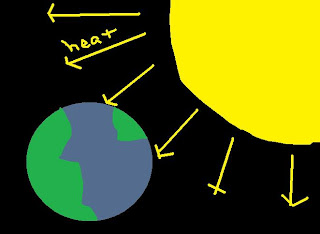
Radiation is electromagnetic waves that transport energy directly through space. An example of radiation is sunlight. Sunlight moves directly through space to Earth, without help from any fluids or solids. Another example of radiation is a light bulb. The closer your hand gets to the light bulb the warmer it feels. The light bulb is emitting heat without any help from fluids or solids, like sunlight.
After we reviewed this, took our density quiz.
- J. L. (Third Blog Post)
Subscribe to:
Posts (Atom)