Saturday, March 12, 2011

Hi everyone!
Today is March 11, 2011

The first thing we did today was go over the homework.
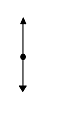
We added in arrows to the dot diagram in between the dot because we realized that regular dot diagrams are way too primitive. The arrows show direction, and speed (the longer it is, the faster it goes)

Here is a description of the dot diagrams
A) The dots get further apart as they go up. The arrows point up
B) The arrows get closer together as they go up. The arrows are pointing up.
C) There is just one dot
D) The dots get further apart as they go down. The arrows point down
E) The arrows get closer together as they go down. The arrows point down.

The second, third, and fifth one we had questions about

In B:
The ball leaves your hand moving rather fast, but it slows down. This is made very clear by the ball stopping and hovering at the top of its ascent .

In C:There is only one dot in the diagram because at the top of its path, the ball stops and hovers for a very short time. This means it is not moving, and therefore there is only one dot.

In E:There was also a question about E. We wondered why, if you stop it when you catch it, it says it is still going down. Mr. Finley showed us an example. When he caught the object, his arms went down to compensate for the mass of it.

Here is a video showing what would happen in this experiment. It will help explain the things discussed
above.
http://paer.rutgers.edu/pt3/movies/throw.mov

Then Mr.Finley showed us an example. He pushed a dictionary across the table. The book left his hand, then moved across the table, slowied down, and finally stopped
Then we made a force diagram, and explain why this happens.

My group said that Mr. Finley exerted a horizontal force, but once it left his hand,
only the Earth and the table was pulling on it. Then we went over it.

Another group said friction was doing force.

Another idea was that there was unbalanced force being exerted by the surface of the table. In other words, it was pushing back. DB asked if the table could push up and back. We determined that it can. The surface of the table was pushing back, and the whole table was pushing up. This is the solution we went with.

ADVICE:Remember that friction is just like heat. It is NOT a physical object. Juts like you cant add heat, friction can't do force. Only tangible objects can exert force on a system. This is very important to remember, and can be a little bit confusing.

MK(Fourth Post)

Monday, March 7, 2011

March 7th, 2011

Today when we walked into class, we got right to the questions from Friday. We took out our homework from the 3rd, and JF and AL drew the force diagrams on the boards from the picture frame and the car problems.


AL had labeled her force diagram like this (on the top) force exerted from the Earth on Car, then the dot was labeled car, and on the bottom it was the force exerted from the road to on the car. But she had mixed the two up, the force from the Earth was on the bottom, and the road on the top, so JP fixed them.

JF had labeled hers as so; on the top, it was the force from the string and the middle was the picture with the frame and the bottom was the force on the earth

The arrows on the picture frame was very short because the picture frame isn't exerting as much force as the car.


Then Finley showed us a "video" on PHET that was a man pushing a box on the ice and we had to make a force diagram on the "video"

EC and I said that if force is exerted on the box, then the box is going to continue traveling for awhile, but before the earth's force is going to slow the box down.


JG (Fourth Time)

Thursday, March 3, 2011

3/3/2011 Period 2

The main thing we did today was go over the HW, but there were a lot of very important questions that came up. Our HW had 2 questions that each had a, b, and c.

Question 1 had a scenario about a jacket on a hook.
A said: what are the objects with which the jacket interacts? What object is our system?
When we discussed this in class we came up with the jacket touching the hook, and that the jacket was the point of interest and the system.

B said: Represent the situation with a force diagram.
The force diagram looked a little like this. The hook was pushing the jacket up, and the earth was pulling the jacket down. The arrows have to be equal because if the hook exerted more force than the earth the jacket would keep rising, if the earth was exerting more force than it would pull the jacket down to the ground.


Hook
+70N


Jacket
0N

Earth
-70N


Alexia had a great comment about the hook, she thought that the hook wasn't exerting any force. That's when we had a class discussion and found out that if the hook wasn't exerting any force than the jacket would just fall because there is nothing holding it up..

C said: How would the force diagram change if you put a heavy book in your pocket.
If you put a book in your pocket than the diagram would look more like this. The earth would be exerting more force downward and the hook would be exerting more force upward. The jacket would still be in the same spot because the forces are still equal.


Hook
+100N

Jacket
0N


Earth
-100N


Question 2 was about 2 people carrying a suitcase.

You had to make a # sentence and a force diagram for A. The # sentence i used was +20 + -20 = 0, and this was my force diagram.


People
+20
Suitcase
0N
Earth
-20N
For B you needed to put the total force exerted on the suitcase. That would be again O because 20+(-20) is 0.

C asked how you decided which side you decided was to be positive and which negative. The positive side goes up because the positive side is always represented by going up or right and the negative side is always represented by left or down.

We didn't do anything else in class to today, but we do have 4 Q's for HW.

JB Post #3

Wednesday, March 2, 2011

New Unit - Astronomy

Today we are starting a new unit - Astronomy


We started off class with a demonstration of holding a bowling ball in one hand and a ping pong ball in the other. Then we observed what happened.

  • You have to push up to hold each ball

  • There is a different push on both sides because of the weight difference


We then discussed a new term, force, and that you are applying force to the ball to hold it.
Force - Interaction between 2 or more objects. (push, pull, etc.)


Next, we talked about what the previous class had said about this demonstration.

"The student had to have done work to the ball in order to hold it up." This is not true because you are applying force to the ball, not work. The ball has gravitational potential energy when it's being held, but nothing is doing work to it.


QuEsTiOnS

+What would happen is this was the only force exerting the bowling ball?

-The only force is pushing up, so it would keep going up and not come down


+Are there any other objects exerting a force?

-The earth is pushing the ball down.


There is an equal amount of force on both sides so it is balanced.
Our number statement for this scenario would be: +7 + -7 = 0


This is because you are giving the ball energy when you hold it above the ground. The earth is pushing down on the ball, making it lose its energy.

During class today, someone mentioned something about the displacement of the ball. I didn't really understand that and why it was displacement. Could anyone tell me about it?

EE (3rd blog)

Thursday, February 17, 2011

February 17, 2011 #3


Today in class, we reviewed atoms and subatomic particles again.
We reviewed that:
  • atoms are made of smaller particles.
  • those particles are called subatomic particles.
  • there are three different types of subatomic particles: protons, neutrons, and electrons
We also did a PhET Simulation called Build an Atom and used it to answer six questions. The Build an Atom simulation was a simulation where we added and took away different subatomic particles to determine what element the atom was, whether it was an ion, what the atomic mass was, whether it was unstable or stable, what charge it was, and how it looked on the periodic table.

These were the questions that we needed to answer:

+ What do these particles do? (charges)

The protons and electrons determine the charge of the atom. If there are more protons than electrons in an atom, the charge is positive. If there are more electrons than protons, the charge is negative. If there is the same amount of protons and electrons, the charge is neutral.

+What controls an element's identity?

The number of protons determine the element's identity.

+What controls the atomic mass of an atom?

The mass of the protons and neutrons determine the atomic mass of the atoms.

+What is an Ion? An Isotope?

An ion is a negatively or positively charged atom. An isotope is an atom with an irregular number of neutrons.

+What does all of the numbers and letters refer to in each periodic table box?

The number in the top left corner of the box is the atomic mass of the atom. The number in the bottom left corner is the number of protons in the atom. The letter in the middle of the box determines what element the atom is going to be. The number in the top right corner of the box whether atom is positively charged or negatively charged and how many particles make it positive or negative.

We used the simulation and previous notes to answer these questions, but I am still confused what makes an atom stable or unstable.

-CS

Wednesday, February 16, 2011

February 16, 2011


Today, we started class today by continuing working on this question:

In small groups, you will devise a plan on how to separate the following frozen mixture of sawdust, iron fillings, sand, and sugar.

Ever group discussed with there tables about how they are going to separate these.


Our group said that we would melt the ice cube in a glass container. The less dense material (wood) will be floating and we will scoop it out. Then we will use a magnet to attract the iron filling out of the water. Then we will pour the water, sand, and sugar mixture through a coffee filter and into a glass container so the sand and water/sugar is separated. After that, we will heat the water/sugar mixture. We predict that by doing this, the water will evaporate and the sugar would stay in the glass container.


After we came up our own experiments, we performed it. This experiment has to be done within the class period.


When performing our experiment, we were very careful when heating the water with dissolved sugar. Another group heated the water/sugar for too much and had the same outcomes as our sugar lab. I am not really sure about how to prevent this. Is there a certain temperature that sugar separates to carbon and water?
-AT 3rd Blog

Tuesday, February 15, 2011

Friday 18, 2011

Sorry but this blog is really late, this is supposed to be from Friday...

Today we came in and the first thing we did was to get goggles and an apron. We were going to start our experiment for our lab report.

So the first thing we did was to make sure we had everything. The materials we used were...


  • Gauge
  • Test Tube
  • Test Tube Grabber
  • 15-20ml of Sugar
  • Saucer
  • Saucer 2
  • Matches
  • Bunsin Burner

Before we did anything, as a class, we talked about the background information we got for our lab which was the homework from the night before. Some the the information was about John Dulton, atoms, particle motions, conservation of mass, decomposition, synthesis, states of matter, and sugar(C12H22O11).

Our experiment was to decompose 20ml of sugar. Our first step was to weigh all of the items that i listed above.

Our hypothesis was that sugar is made up of 2 things. Water and Carbon because sugar is C12H22O11. The C part is carbon and the H20 part is water. So our prediction was that if we were to evaporate the water by boiling the sugar, there should only be carbon left in the test tube. Also if conservation of mass were true, the test tube with sugar in it should weigh less than before the water was boiled out of it.

We were ready to experiment. First thing we did was to turn on the Bunsin Burner. We took a match and we put the flame over the bunsin burner, and it was on fire. Then we took the test tube with sugar in it, and used the test tube grabber to put it over the fire. In about a minute we already saw changes happening. At the bottom of the tube that was being heated the most, it seemed like the sugar was turning into a liquid. Moments later, the liquid turned into a yellow-ish color. The level of the sugar started rising to the top of the test tube as water was evaporating. It turned purple like black and there was water particles escaping and we trapped it with the saucer. As more water particles came, it turned back into water and dripped down. After we felt like there was no more water left, we turned off the bunsin burner and put the carbon filled test tube away.


Later in the day, we came back to see how the carbon was like. It was still black and hardened. We took paper towels, wrapped the test tube, and smashed it. The carbon came out looking like this.

That was it with our experiment, but now we have a whole lab report to write about this. We need background information, hypothesis, prediction, materials, experiment, analysis, and a conclusion. The lab report will be due sometime around next week. The test will be on Friday.

Y.E